Sock Yarn Guide: Types, Weights & How Much You Need
August 29, 2025
How to Measure Feet & Calculate Sock Size for Knitting
September 5, 2025Sock Knitting Needles & Accessories: A Complete Guide

Originally published on August 31, 2025
If you caught my last post about sock yarn, you know just how much thought goes into every cozy pair of handknit socks. But the right needles and a few smart accessories can make sock knitting so much smoother (and more enjoyable!). Whether a brand new sock knitter or coming back for a fresh project, here’s a practical guide to the tools that help socks slide off the needles with joy.
  |
All About Needles & Accessories for Sock Knitting |
Table of Contents
Best Needles for Sock Knitting: A Comparison
Here’s the thing: there isn’t one perfect needle for knitting socks, it’s all about finding what feels right for you. I’ve tried several kinds over lots of sock projects and discovered I’m happiest using DPNs. If you’re just starting with sock knitting, seeing all the choices can be a bit much. The easiest way is to give each option a try, one at a time, and see what you like. I’ve listed four popular types of needles below that I’ll talk about:
Sock Needle Comparison Table
I’ve created a quick comparison table of the four main sock knitting needle types. You’ll find a detailed review of each style in the sections below.
|
Needle Type |
Pros |
Cons |
Best For |
Price Range |
|
DPNs (Double-Pointed Needles) |
Widely supported by sock patterns Excellent for precise shaping (heels, toes) Affordable, easy to find in many materials |
Can cause laddering between needles Needles and stitches can slip or get lost Not suited for two-at-a-time socks |
Versatile for various circumferences Complex shaping Options in various lengths/materials |
€5-€15 per set |
|
Magic Loop |
Uses one long circular needle, fewer tools to manage Great for knitting two socks at once Reduces laddering risks Portable and versatile |
Takes time to learn/setup Frequent loop/tension adjustments can slow knitting Long cables may get tangled in small spaces |
Knitting two-at-a-time socks Travelling Versatile for various circumferences |
€8-€18 per needle |
|
FlexiFlips (or similar tri-fold) |
Faster rounds with fewer transitions Needle flexibility makes adjusting stitches easier Compact |
Learning curve for dual-tip design Some adjustments to patterns may be needed |
Speedy sock knitting Intricate patterns (sharp tip) Comfort and portability |
€15-€25 per set |
|
Short Circulars (9-12") |
Only two needle tips to manage, reducing dropped stitches Fast, streamlined knitting for sock legs Less laddering Compact and portable |
Very short tips can cause hand cramping/fatigue, especially with larger hands Not ergonomic for longer sessions May need DPNs/Magic Loop for toes/heels |
Fast tube knitting Smaller hands Travel projects |
€7-€18 per needle |
A little side joke: When I was researching the prices for needles, I left out my own country, Austria. With our inflation, knitting with chopsticks might actually be the cheaper option! 😊
Double Pointed Needles (DPNs): Pros, Cons, & Tips
If you’re learning how to knit socks, you’ll soon meet double pointed needles (DPNs) - a favorite tool among sock knitters. When I began sock knitting, I started with a set of five DPNs (usually four holding the stitches, with one working needle). It can genuinely feel like “wrestling a hedgehog” at first (and many knitters will agree!), but with a little patience, your hands will quickly find their rhythm and your confidence will grow.
Most double pointed needle sets come in five and are available in several sizes and lenghts. The right lenght is personal, but for small sock circumferences, I always reach for the 15cm (5.91 inch) DPNs - they’re much handier for small circumferences, and less likely to sneak into your stitches and pull them out accidentally (believe me, it happens to everyone). You’ll also find 20cm (7.87 inch) and 25cm options if you prefer something longer.
DPNs offer fantastic control over your knitting, especially for sock projects. Many knitters love the traditional feel and flexibility DPNs provide - and once you get the hang of it, you might never want to knit socks any other way
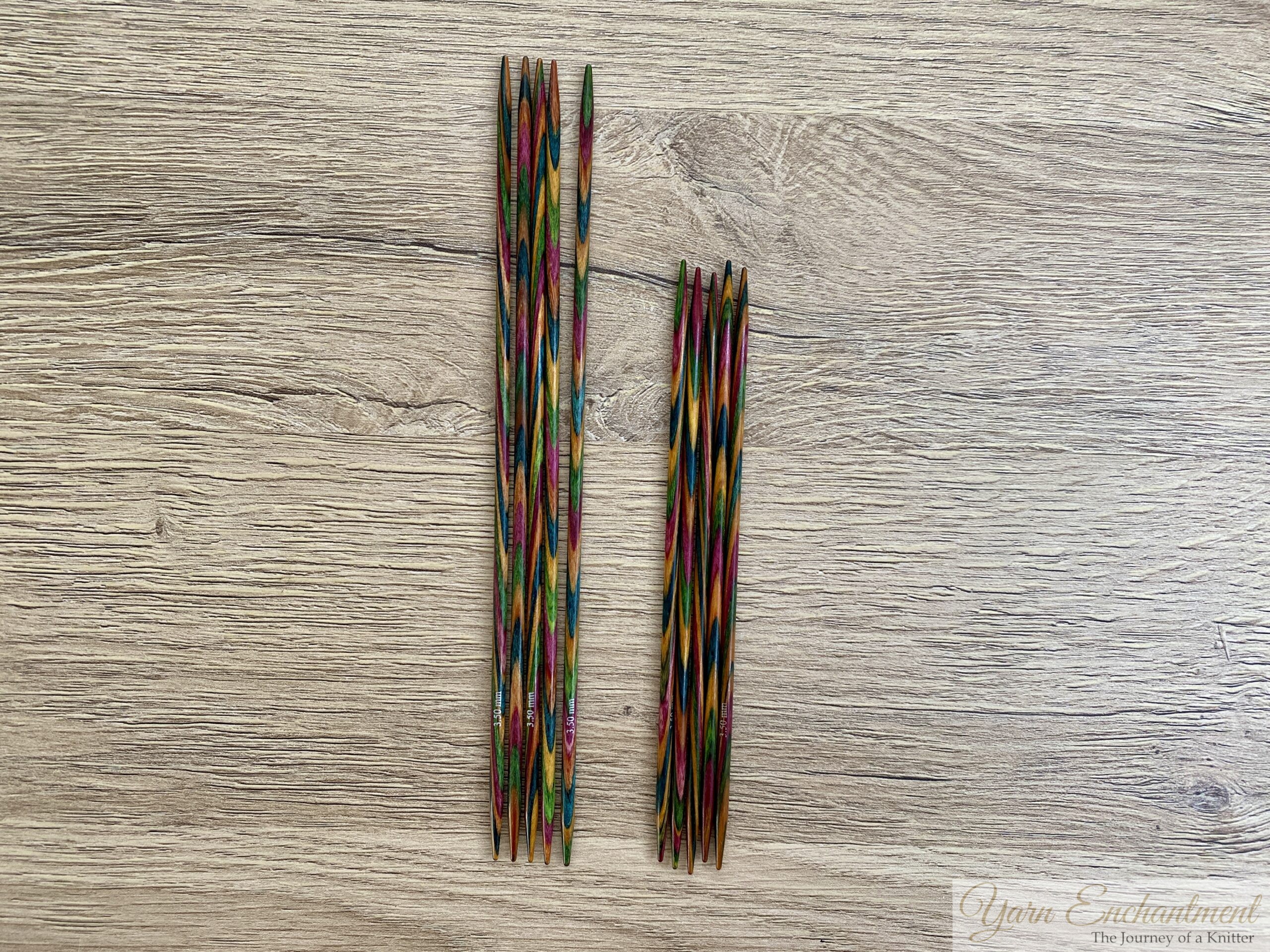  |
Two sets of double pointed needles in different lengths - on the left side are the 20cm (7.87 inch) needles, and on the right side are the 15cm (5.91 inch) needles. You can already see how much difference those 5cm (1.97 inch) make when choosing the perfect size for your project. |
Short Circular Needles for Socks: Features & Use Cases
When it comes to sock knitting, short circular needles have their fans, but I’ll admit, they aren’t my personal favorite. Whenever I use a 30cm (12 inch) circular needle for knitting socks, I often find my hands cramping, so I usually save these for colorwork or projects with very small circumferences, where they really help me control my tension.
I’ve chatted with other knitters who absolutely love short circular knitting needles for socks. They talk about how speedy these needles are, and how their compact size makes them perfect for portable knitting or travel knitting. If you’re always on the go, short circulars might be your best friend! The classic size is 30cm (12 inches), but you’ll also come across options ranging from 20cm to 30cm (about 9 to 12 inches). Just remember, when it’s time to knit the heels or toes, keep a set of double pointed needles handy - short circulars can be tricky when there aren’t enough stitches to easily fill the needle.
In summary: Short circular knitting needles for socks are fast and travel-friendly, but may not be for everyone. They’re especially useful for knitting in the round on smaller circumferences, but many knitters prefer to switch to double pointed needles or another method for tricky sections like heels and toes.
  |
This isn’t a classic short circular needle, mine is a bit special. It’s called “Sockenwunder” (or “Sockmiracle” in English), and it’s designed with a longer right needle tip and a shorter left tip. That little difference gives my dominant hand a better grip, making it possible for me to knit with short circular needles. |
Magic Loop Method for Sock Knitting
The Magic Loop method might sound a bit daunting at first, but it quickly becomes a sock knitter’s best friend, especially if you want to knit two socks at once! All you need is a long circular knitting needle, usually 80cm (32 inches) or longer, and you’ll find the technique is much easier than it looks.
One of the biggest benefits of the Magic Loop method for socks is that it’s incredibly portable and helps you avoid “second sock syndrome” - you can work on both socks together and never worry about losing track or motivation. If you love travel-friendly projects and want a satisfying way to knit perfectly matching socks, the Magic Loop is absolutely worth a try.
  |
This is a long circular needle (80cm/32") - the essential tool for the Magic Loop method, making it easy to knit two socks at once.You can knit any small circumference using this method. |
FlexiFlips & Trio Needles: Alternative Sock Knitting Tools
Trio needles (also known as FlexiFlips) are a great option for sock knitting and other small circumference projects. Each set includes three double pointed needles, each with a flexible cable in the middle, and they’re usually available in sizes from 2 mm to 5 mm. Many knitters love Trio/Flexi needles because you only need to change needles twice per round, making them more comfortable and less fiddly than traditional double pointed needles.
These flexible needles are especially handy for socks, sleeves, or even mittens. I've read that the unique design helps keep your hands relaxed, and makes it less likely for needles to slip out of your stitches, a big plus if you knit loosely or experience hand strain. Personally, I’m hoping to try Trio needles for sleeve colorwork soon; they seem like a fantastic alternative to small circulars, and I love how ergonomic they look. The only drawback is that they tend to be a little pricier, but many knitters say the comfort is worth it! (This probably sounds like an advertisement! 😄 But I don’t have them myself yet, so I can only share what I’ve read about them.)
Honestly, don’t worry if you don’t find your perfect knitting needle right away. Exploring different knitting tools is part of the journey, and with a little experimenting, you’ll soon discover what feels most comfortable for your projects and your hands.
Essential Accessories for Successful Sock Knitting
- Sock Yarn: Most socks use fingering/4-ply yarn, often a blend like 75% wool/25% nylon. Expect to use 100-150g for adult socks, more for chunkier styles.
- Tapestry Needle: For weaving in ends and that crucial Kitchener stitch at the toe.
- Scissors: Any sharp, small pair will do.
- Measuring Tape: You’ll want to measure the cuff, foot, and everything in between.
- Stitch Markers: I like to place stitch markers where I start my heel flap, after the gusset decreases, and before beginning my toe decreases. This way, I can match up my second sock perfectly with the first, making it much easier to ensure both socks are identical.
- Row Counter: Not a must, but it’s fantastic for keeping your decreases and repeats on point. You can also use a Notebook.
- Needle Stoppers: Handy little accessories that slide on the tips of your needles or circulars to keep stitches from slipping off when your project is set aside, especially useful if you knit on the go or take frequent breaks.
- Crochet Hook: If you drop some stitches, it’s handy to have a crochet hook nearby to pick them up easily.
- Sock Knitting Tracker: I’ve created something special just for my blog readers - a Printable Free Sock Knitting Tracker! This exclusive tool will help organize every step of sock knitting, from choosing yarn and needles to tracking your progress and making notes about fit and adjustments.
You can keep track of:
-
-
Project details (pattern, yarn, recipient)
-
Yarn, needles, and gauge swatch info
-
Sizing and fit measurements
-
Progress steps for each sock
-
Special notes and stitch marker placements
-
This tracker is designed for personal use and should make every sock project smoother and more enjoyable.
Download your free, exclusive PDF here
There’s no shame in sticking to the absolute basics, but a few extra bits (like a crochet hook for picking up stitches, or a needle stopper to protect your work) can make things easier.
  |
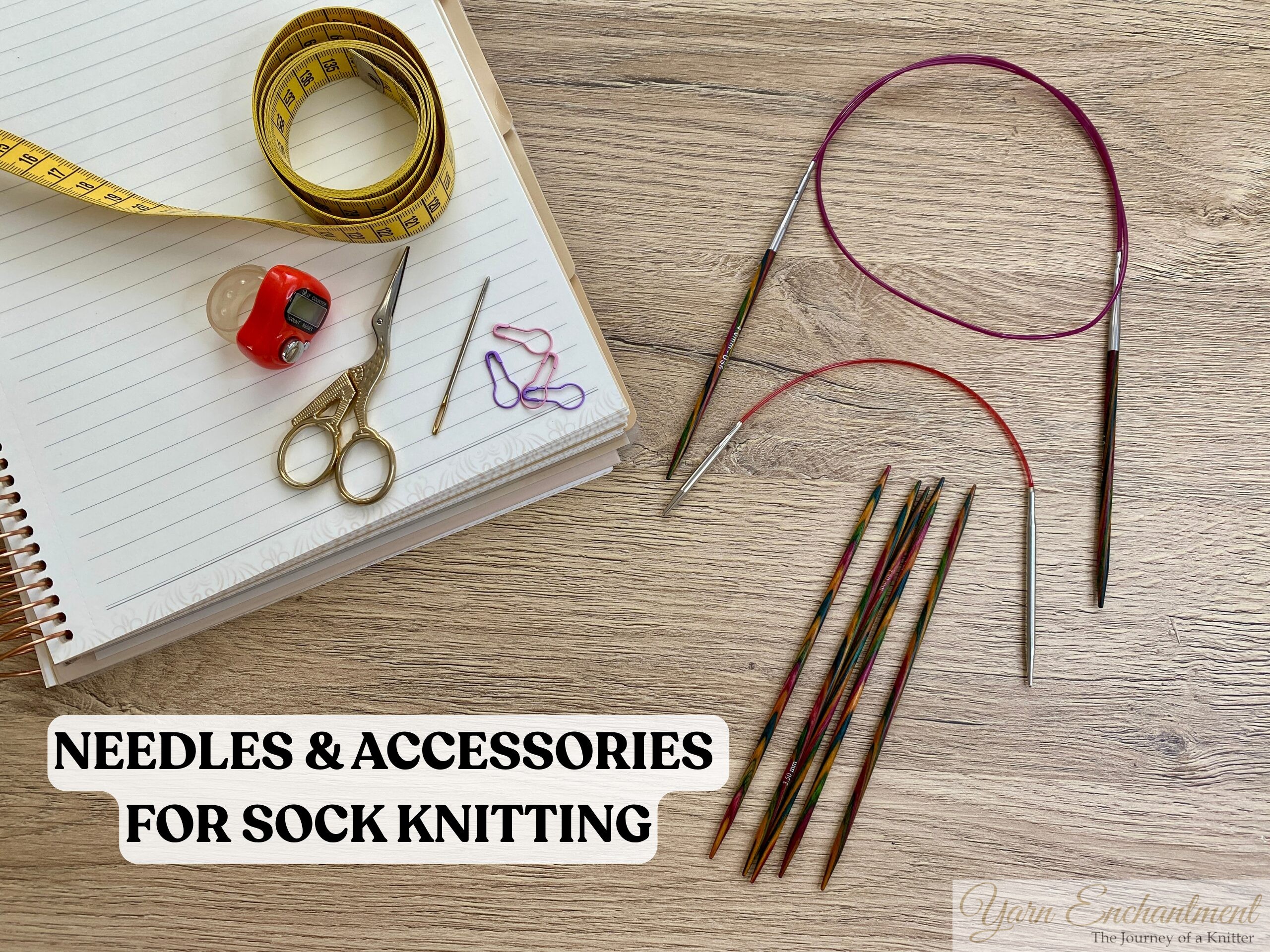
A peek at must-have sock knitting accessories: yarn needle, sharp scissors, stitch markers, measuring tape, row counter, and a handy notebook - simple tools that make sock projects much more fun. |
How to Choose Needle Size & Material for Socks
What Needle Size is Best for Sock Needles?
I use 2.5 mm needles for nearly every sock project when working with 4-ply yarn, and 3.5 mm needles for 6-ply weight yarn. Your gauge may change depending on needle style and often relaxes as you become more comfortable with the process. When buying online, especially if you’re concerned about hand comfort, look for knitting brands with smooth joins, rough connections or stiff cables (especially for the Magic Loop method) can snag your yarn and make magic loop almost impossible, really testing your patience.
Short circulars are available in many lengths and tip shapes (straight or bent), and choosing between wood and metal is all about personal comfort. If you’re unsure, try both! Every pair of socks becomes a mini experiment to discover your favorite tools.
Wooden vs. Metal Needles: My Review & Experience
I started out using metal needles, but over time I switched completely to wooden knitting needles because the metal really hurt my fingers - sometimes even left them bruised (I’m definitely having a tight grip 😄). Wooden needles feel much gentler on my hands and have made my knitting sessions much more comfortable.
Tips for Making Matching, Professional-Looking Socks
Getting two socks to match doesn’t have to be tricky! To create perfectly matching pairs, place stitch markers at key points- such as where you start the heel flap, after the gusset decreases, and just before the toe decreases. This makes it easy to track and repeat the same steps on your second sock. Measuring the length of your cuff, foot, and leg as you go will help keep things consistent between both socks. I’ve also made a sock knitting progress keeper, so you can write down every detail and make sure your socks always match perfectly.
For a neat finish, use a tapestry needle and work the Kitchener stitch to graft the toe - this creates an invisible, flexible seam. When it comes to blocking, you don’t have to use official sock blockers; simply wash your socks and pin them on a blocking board. In fact, I don’t own sock blockers myself, and my socks have always turned out perfectly! Of course, sock blockers do make for pretty pictures. 😄 If you’re gifting your socks or want them to last longer, consider reinforcing the heels and toes with extra yarn or a denser stitch.
With these simple tips, your handmade socks will look neat, fit perfectly, and hold up beautifully.
Sock Knitting Advice for Beginners
Don’t let the needle choices slow you down. Some knitters like me swear by DPNs, some by circulars, and some switch up depending on mood or sock style. Your hands will tell you what feels right - and if you need a break, take it (hands deserve some love too!).
If you get stuck, ask a friend, local yarn shop, or drop a comment. I will always be here to cheer you on or offer a tip.
  |
Sock Knitting Needle & Tool FAQs
Which needles are best for sock knitting?
There’s no single “best” needle, popular options include double pointed needles (DPNs), short circulars, the Magic Loop method, and Trio/Flexi needles. The best choice depends on your personal comfort, project style, and knitting experience. Many knitters experiment to find their favorite.
Can I knit socks without double pointed needles?
Yes! You can knit socks using long circular needles for the Magic Loop method, short circular needles, or Trio/Flexi needles. Many knitters find these alternatives just as effective (or even easier) than DPNs.
What size needles should I use for socks?
Most sock knitters use needle sizes between 2 mm and 2.5 mm (US 0-1.5) with fingering-weight yarn. Adjust your needle size based on your personal gauge and the yarn thickness you’re using.
What accessories do I need to start knitting socks?
The basics include: sock yarn, appropriate needles, a tapestry needle, scissors, measuring tape, stitch markers, a row counter (or notebook), and optional needle stoppers. A few extras like a crochet hook for picking up stitches can also be handy.
Do I need to block my socks after knitting?
Blocking is optional for socks, but it helps even out stitches and gives your finished socks a polished look. You don’t need special sock blockers, a simple wash and pinning your socks to shape works well.
How can I make sure my socks match in size?
Use stitch markers and take notes on key measurements and decreases as you knit your first sock. This makes it easy to replicate the process for your second sock and achieve a matching pair.
Is sock knitting suitable for beginners?
Absolutely! Sock knitting can look intimidating, but starting with a basic pattern and the right tools makes it a fun and rewarding project - even for new knitters.
How to Avoid Hand Strain While Knitting
To keep your hands comfortable while knitting, take regular breaks, sit with good posture, use comfy tools, loosen your grip, and remember to stretch your hands every now and then.
Next Steps in Your Sock Knitting Journey
Gather your needles, pick your accessories, choose your yarn, and get ready for sock fun. In my next post, I’ll talk about swatching for the perfect fit (a little boring, but trust me, it helps!) so your socks fit perfectly.
Let me know your favourite needles or any stories about learning new techniques. Sock knitting is all about joy, connection, and a bit of experimenting.
Until then, happy knitting!
A little update! 🧦 A few of you asked if I could put the whole course into one printable PDF - so I did! If you'd like everything in one place, you can find The Enchanted Sock Workbook right here: [The Ultimate Printable Sock Workbook] And don't worry - the blog and videos will always stay free. This is just for those who love having a printed copy by their knitting chair.
Feeling ready for more sock fun?
Jump into the next parts of my Free Sock Knitting Course! Explore topics like:
- Sock Yarn Guide: Types, Weights & How Much You Need
-
Sock Knitting Needles & Accessories: Complete Guide for Beginners
-
How to Measure Your Foot & Calculate Sock Cast-On Size (Knitting Tutorial)
- How to Knit Socks for Beginners: Cast-On to Leg with DPNs
- How to Knit a Classic Heel Flap & Turn
- Hole-Free Gusset Pick Up and Decreases for Perfectly Fitting Socks
- Complete Foot and Wedge Toe Sock Guide: Measuring, Sizing & Decreasing
A Little Way to Say Thanks
Yarn Enchantment is my cozy hobby corner on the internet. If something here made your knitting day easier or you simply enjoy reading my posts and would like to say thank you, you can leave a small Ko-fi tip - but only if you truly want to.
My patterns and tutorials stay free for everyone, always. Every little tip just goes toward new yarn and a cup of tea for my cozy knitting evenings.
☕ Support me on Ko-fi
You Might Also Like


 |
|
Join the Cozy Corner Newsletter
Hello, creative soul. Welcome to the Yarn Enchantment Newsletter, a little space where we celebrate all things cozy, crafty, and full of heart. Think of this as your friendly crafting companion, a soft dose of inspiration delivered straight to your inbox, just for you. Each newsletter brings you: ✨ Notifications about new patterns and tutorials – easy knitting patterns and beginner crochet projects you won’t find anywhere else 🧶 Practical yarn tips for new crafters, plus advice on the best yarn for fall, blankets, and handmade gifts 💌 Small stories and adventures from my own workbench, because crafting is as much about the journey as the finished piece Whether you’re knitting by the fire, looking for your next creative spark, or simply wanting a quiet moment with your hooks and needles, this newsletter is here to cheer you on. Crafting isn’t just about the final project. It’s about the joy, the peace, and the stories we weave along the way. So grab a cup of tea or coffee, settle in, and join me. Together we’ll make a little magic, one stitch and one story at a time. I’m so glad you’re here. Let’s create something beautiful together. Sign up below to receive your first email, and feel free to leave a comment on the blog if there’s a topic you’d love to see covered. Your ideas might just become our next newsletter feature. |