

How to Knit I-Cords: Neat Results with 2–7 Stitches
November 4, 2025
Ultimate List of Knitting Abbreviations: Increases, Decreases, Cables & More
November 18, 2025PetiteKnit Sophie Hood Pattern Review & Knitting Tips

Originally published on November 11, 2025
I recently finished knitting the popular Sophie Hood pattern by PetiteKnit, so this post is both my Sophie Hood knitting review and a collection of helpful tips for anyone considering this cozy winter accessory. If, like me, you’re looking for a practical winter hood pattern to keep your ears warm when the cold winds arrive, the Sophie Hood is a stylish and functional choice.
This post contains affiliate links. I may earn a small commission at no extra cost to you. I share products I actually use and love.
Sophie Hood worn by me :D


Why Choose the Sophie Hood?
After completing my recent sock course, I decided to try the Sophie Hood and purchased both the pattern and the yarn. With so many hooded knitting patterns available, many of which look quite similar, I chose a PetiteKnit design for one key reason: her patterns are extremely popular in the knitting community. This popularity means there’s a wealth of helpful tips, video tutorials, and step-by-step guidance online, making it less daunting for knitters of any skill level.
Sophie Hood from the side


Yarn Choice: Drops Air Review
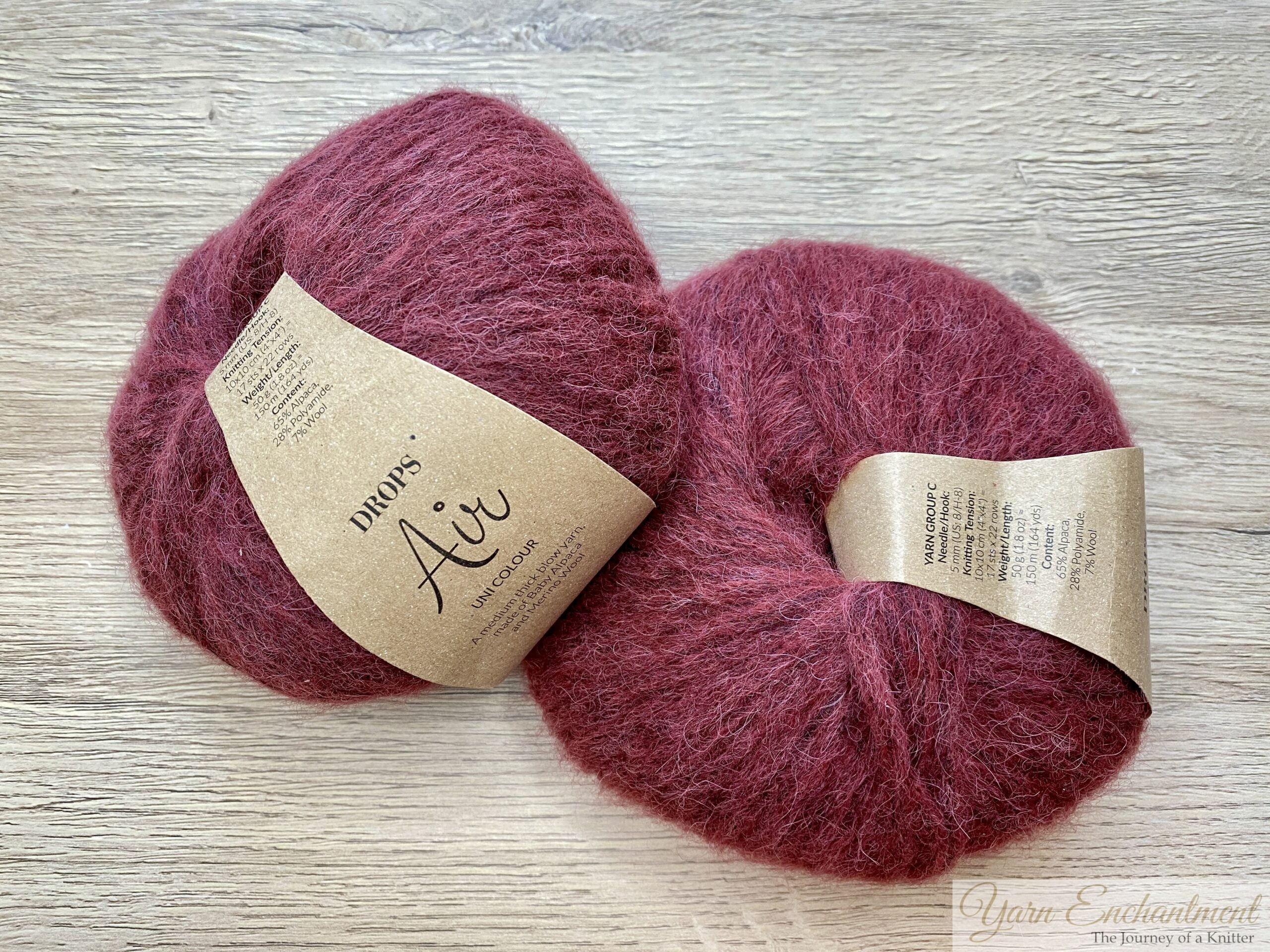
For this project, I selected Drops Air yarn in the color bordeaux. Originally, I wanted crimson red, but I’m actually glad the online shop I purchased from was out of that shade. At first, I was unsure if bordeaux would suit me because it has a rusty red look, but I quickly grew to love it. I believe this color is warm and perfect for both me and the autumn season. Drops Air is an ultra-light, exceptionally warm “blow yarn,” making it ideal for patterns where you want a hood that feels like a gentle, cozy hug. If you’d like to learn more about blow yarn, check out my updated Yarn Types Guide and Drops Design Yarn Review. Both resources cover the properties and advantages of blow yarns.
Drops Air in Bordeux

Sophie Hood Pattern Construction Explained
The Sophie Hood is constructed starting from the tip and shaped with increases. Once you reach the required stitch count, the hood shape is formed using a combination of increases and decreases. After completing the hood section, you continue by knitting the other side of the scarf, working downward with decreases to finish the shape. You finalize the project by joining the back of the hood with mattress stitch for a seamless result.
Here’s what you can expect when working on the Sophie Hood, along with some tips from my own experience to help you avoid common pitfalls.
Navigating Pattern Challenges and Tips
While the overall construction is straightforward, some wording in the pattern may be a bit confusing, possibly due to translation differences. For example, if you want to work more increases for a wider hood, the instructions say to increase or decrease until you reach the "correct width" for your scarf, but only specify the finished scarf width (like 25 cm). The pattern doesn’t indicate the target width immediately after shaping (decreasing) the hood, so you’ll need to do a bit of math using your gauge and stitch count.
For instance, after finishing the last decrease in the hood section, you should have 23 stitches. If you use the recommended gauge of 17 stitches per 10 cm, this gives you a width of around 13.5 cm at the narrowest point, which is much slimmer than the finished scarf and not directly stated in the instructions. Because of this, it’s best to calculate your actual width after shaping the hood, then adjust increases or decreases as needed to hit the final measurements.
Sophie Hood from behind


How to Track Increases and Decreases
The pattern asks you to work increases or decreases on a specific row, for example, every -th, -th, or -th row. Here’s a simple way to keep track:
-
When it’s time for an increase or decrease, work it exactly as the pattern instructs.
-
Immediately after completing this increase or decrease, reset your row counter to zero.
-
The first row you knit after the increase or decrease will be a right side row. Call this row 1.
-
Continue knitting and counting each row with a counter.
-
For example, if your pattern says to increase every 10th row, when your row count reaches 9, the next row (the 10th) will be a wrong side row where you work your next increase or decrease.
-
After completing that increase or decrease, reset your counter back to zero and repeat the process as many times as necessary.
Using a row counter or progress keeper makes it easy to stay organized and ensures your increases or decreases happen at exactly the right place in the pattern.
Just a quick note: To respect the designer’s copyright, I’m keeping things general rather than sharing exact row counts. Instead, my aim is to offer practical tips and guidance so you can get great results while supporting the original pattern author.
I-Cord Edging: Knitting Advice
One thing that made a big difference for me: the I-cord edging stayed much straighter and neater when I left it alone and didn’t try to work increases directly in those stitches. While the pattern suggests working the increases into the third I-cord stitch, you don’t have to stick to that if you’re not happy with the result.
Remember, every pattern you knit is like a blank canvas, you don’t have to follow every single construction detail if you think another technique will suit you better. Trust your instincts and make the project your own! Being creative is part of the fun.
After knitting a few gauge swatches, I realized I preferred to approach the increases and decreases a little differently. I worked the three I-cord stitches first, then added my increases using a knit front and back (KFB). For the decreases, I chose knit two together (k2tog), which gave a much neater edge, honestly, it doesn’t really matter which direction the decrease leans as long as your edges stay tidy.
A sample from the I-cord edging and the kfb increases: I worked the increases directly after the three I-cord stitches, and as you can see, the edging is really neat - not wobbly, and it does not have any holes.
The I-cord edging on my finished knitted hoodie.


Increase and Decrease Tips for Beginners
- Use a row counter or progress keeper to mark your increase rows, especially if the pattern calls for increasing every -th, -th, or -th row, depending on your chosen size.
- Work increases (such as KFB) just outside of the I-cord edge (for example, after knitting the I-cord stitches), rather than within the I-cord itself, for a tidier and straighter edge.
- Double-check which row is your "wrong side" or "increase row" by marking it visually with a stitch marker, this helps avoid missing increases or placing them incorrectly.
- If you notice any tightness or holes after an increase, gently adjust your tension and block the finished hood to even out stitches.
- Don’t worry too much about the direction of the decreases, they are so far apart that no one will see.
The full Sophie Hood by PetiteKnit


Blocking and Sizing with Drops Air
Watch Out for Yarn Stretch!
One of the things I absolutely loved about using Drops Air is how soft it feels, it doesn’t scratch or itch at all. That makes it perfect for a pattern like the Sophie Hood, which sits directly against your skin. The yarn is also incredibly bouncy and grows quite a bit after washing, so be warned: my finished hood ended up huge!
Before blocking, my Sophie Hood measured around 140 cm from the center of the hood down to the tip. After a gentle block, one side stretched out to 175 cm, really showing off the yarn’s airy texture. Honestly, this only happened because I didn’t knit a gauge swatch, I’ll admit I usually skip gauge swatches for scarves - after all, a little size variation isn’t a problem. With scarves, I find it’s fine if the final size is a bit larger, and if it ever turns out smaller I can always add a few more increases.
If you're looking for a feather-light accessory with lots of coziness, Drops Air is a fantastic choice. And don’t underestimate the magic of blocking, those extra centimeters truly make your hood feel like a warm, cozy hug every time you wear it.
I wrapped the Sophie Hood twice around my neck, and it’s still impressively long.


Conclusion
Knitting the Sophie Hood by PetiteKnit was truly fun and enjoyable, offering lasting comfort and warmth for winter without requiring advanced techniques or complex skills. The straightforward construction, paired with the softness of Drops Air, makes this project ideal for beginners and experienced knitters alike, especially when you want a relaxing knit that doesn’t demand constant attention. If you’re looking for a cozy, customizable accessory to brighten your winter wardrobe, the Sophie Hood is the perfect way to add a touch of handmade charm. Enjoy every stitch, and stay warm through the season!
Until then, happy knitting!
Sophie Hood Project Details
Pattern: Sophie Hood by PetiteKnit
Size: L (Large)
Needles & Yarn
Needles: US 8 (5.0 mm) circulars
Yarn: Drops Air Colorway 57 (Bordeaux), 3.4 skeins (about 510 meters / 170 grams total)
Sophie Hood by PetiteKnit


A Little Way to Say Thanks
Yarn Enchantment is my cozy hobby corner on the internet. If something here made your knitting day easier or you simply enjoy reading my posts and would like to say thank you, you can leave a small Ko-fi tip - but only if you truly want to.
My patterns and tutorials stay free for everyone, always. Every little tip just goes toward new yarn and a cup of tea for my cozy knitting evenings.
☕ Support me on Ko-fi
You Might Also Like


 |
|
Join the Cozy Corner Newsletter
Hello, creative soul. Welcome to the Yarn Enchantment Newsletter, a little space where we celebrate all things cozy, crafty, and full of heart. Think of this as your friendly crafting companion, a soft dose of inspiration delivered straight to your inbox, just for you. Each newsletter brings you: ✨ Notifications about new patterns and tutorials – easy knitting patterns and beginner crochet projects you won’t find anywhere else 🧶 Practical yarn tips for new crafters, plus advice on the best yarn for fall, blankets, and handmade gifts 💌 Small stories and adventures from my own workbench, because crafting is as much about the journey as the finished piece Whether you’re knitting by the fire, looking for your next creative spark, or simply wanting a quiet moment with your hooks and needles, this newsletter is here to cheer you on. Crafting isn’t just about the final project. It’s about the joy, the peace, and the stories we weave along the way. So grab a cup of tea or coffee, settle in, and join me. Together we’ll make a little magic, one stitch and one story at a time. I’m so glad you’re here. Let’s create something beautiful together. Sign up below to receive your first email, and feel free to leave a comment on the blog if there’s a topic you’d love to see covered. Your ideas might just become our next newsletter feature. |


4 Comments
Hola 👋🧶 Espero aprender de ustedes y compartir experiencias 🧣🧕🧶 Saludos
Hello 👋🧶
Thank you so much!
Hey, your blog is enchanting (: I came here through Pinterest. Have you any tipps for ending the sophie scarf/hood? I always mess it up ): I’ve done my second sophie and I’m just not satisfied with how it looks.
Best regards, Christine
Hello Christine,
Thank you so much for your nice words, I am really happy to read that.
I am very sorry, but I am not sure what you mean. Do you mean decreasing downwards to the end, or the cast-off itself? When it comes to finishing it, I cast off the last stitches according to the pattern. For the decreases, I am working a k2tog right after the three i-cord stitches are worked.
I hope this helps a little bit. I am very sorry that it took me so long to reply, but I had a few health issues.
Warmly,
Sarah